
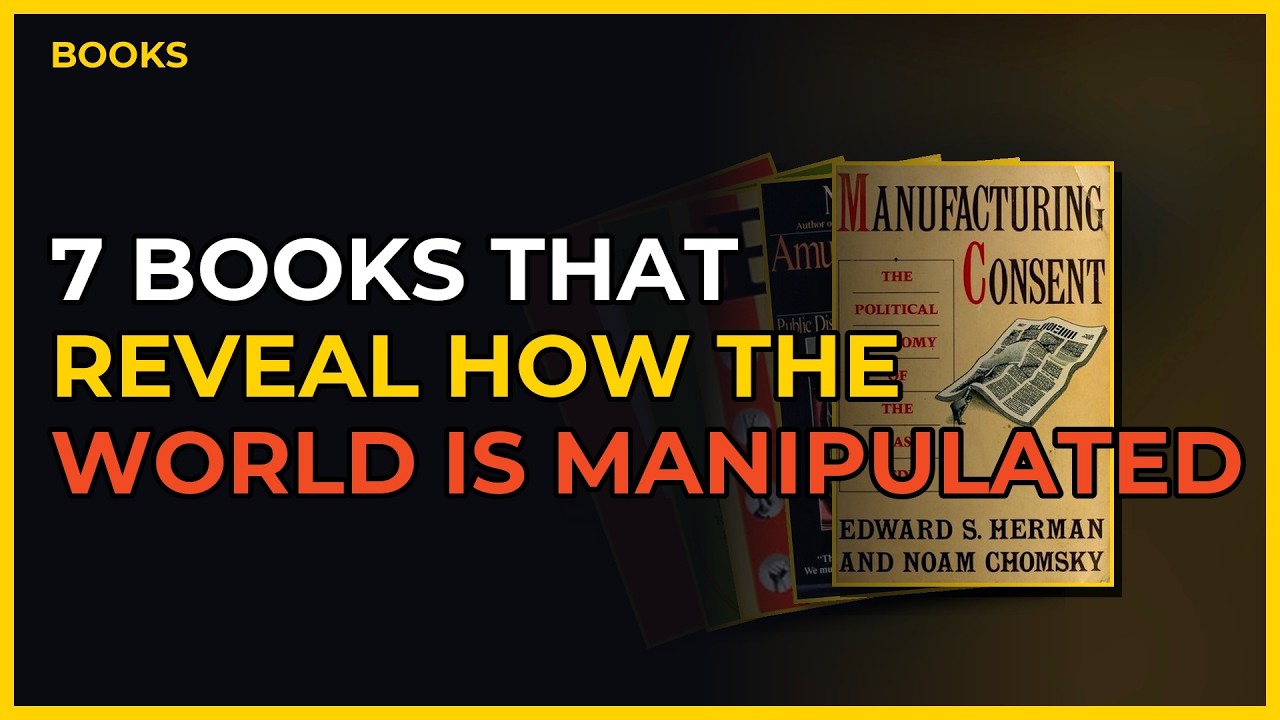
Explore seven books that expose the invisible systems shaping your opinions, fears, spending, and identity. These works don’t just explain the world; they rewire how you see it forever, revealing how almost everything you believe might be carefully engineered. Prepare to challenge your perceptions and understand the mechanisms of influence at play.
1. Manufacturing Consent

Manufacturing Consent — Noam Chomsky & Edward S. Herman
The propaganda model suggests that mainstream media filters reality through corporate and political interests, choosing news not for truth but for its service to power. The silence in news stories can be more telling than the coverage itself. This book explains exactly why certain information is omitted, changing everything about how you consume media.
Who it’s for. Anyone who has felt that something was left out of a news story, or that the silence was louder than the coverage.
What to do with it. Start asking not just what the media is saying, but what it is systematically not saying, and who benefits from that silence.
Full page on “Manufacturing Consent”: who it’s for and when to read it
2. Amusing Ourselves to Death

Amusing Ourselves to Death — Neil Postman
Television and social media don’t just entertain; they restructure how we think. When information becomes spectacle, serious thought becomes impossible, leading us to crave distraction and call it freedom. The medium itself rewires your capacity for depth, patience, and critical thought, shaping what thoughts are even possible for you.
Who it’s for. Anyone who scrolls for hours and feels somehow emptier afterward.
What to do with it. Audit your information diet the way you’d audit your food, considering not just content but the medium that delivers it.
3. Propaganda

Propaganda — Edward Bernays
This book openly explains how to engineer mass consent, asserting that in a complex society, the masses must be influenced, and those who do it invisibly hold the real power. Reading this book makes you fluent in a language that has been spoken at you your entire life without your knowledge or consent.
Who it’s for. Anyone seeking to understand the mechanics of public relations and mass influence.
What to do with it. Reverse-engineer every campaign, product launch, or political movement you encounter by asking about the client, the belief being installed, and the emotion being exploited.
4. The True Believer

The True Believer — Eric Hoffer
Mass movements—religious, political, revolutionary—are not primarily driven by ideas but by frustrated people desperate to lose themselves in something larger. The psychology of the participants is key, not necessarily the cause itself. Hoffer answers without flinching how people become deeply committed to movements, and humility about your own beliefs is the only real protection.
Who it’s for. Anyone who has wondered how ordinary people join cults, follow demagogues, or commit atrocities for a flag.
What to do with it. Examine your own certainties, recognizing that conviction of clear sight can be part of the mechanism of belief.
5. Debt: The First 5,000 Years

Debt: The First 5,000 Years — David Graeber
This book dismantles the myth that markets and trade came before debt, revealing that debt came first and was always loaded with moral weight, serving as a tool for power, obligation, and control of populations. Understanding the history of debt helps the shame it manufactures lose its grip on you completely.
Who it’s for. Anyone feeling crushed by financial anxiety, student loans, or the invisible weight of economic obligation.
What to do with it. Stop treating debt as a neutral financial fact and start seeing it as a political and moral relationship that can be renegotiated, challenged, and reframed.
6. The Shock Doctrine

The Shock Doctrine — Naomi Klein
Klein’s central revelation is disaster capitalism—the deliberate exploitation of crises like war, floods, or economic collapse to push through radical economic policies that populations would never accept under normal conditions. Shock is a strategy, not just a side effect. Critical thinking is most necessary precisely when it feels most dangerous, and this book explains why.
Who it’s for. Anyone who has noticed that major policy changes often occur during crises, when debate is suspended and urgency is weaponized.
What to do with it. Slow down during emergencies, not speed up, and recognize that demands for immediate drastic change are often a form of manipulation.
7. Simulacra and Simulation

Simulacra and Simulation — Jean Baudrillard
We no longer live in reality but in a simulation of reality—a world of signs, images, and models that have replaced the real things they once represented. The map has eaten the territory, and the world now imitates media, making nothing mean what it appears to mean. Once you see the simulation, you can never unsee it, offering both a gift of insight and a warning.
Who it’s for. Anyone who senses that public reality—politics, news, culture, war—feels increasingly like a performance with no backstage.
What to do with it. Stop asking whether media images are true or false, and start asking what reality they are constructing and who profits from that construction.
Not sure what order to read them in? Get The 1% Reading Path: 20 books in the exact order to read them, free PDF.